

Brass Coil Manufacturer Guide for General Industrial Buyers
Brass Coil Manufacturer Guide for General Industrial Buyers
Brass Coil Manufacturer Guide for General Industrial Buyers
Buyers sourcing brass coil for general industrial use typically face four decisions: which grade, which temper, which process route, and what documentation ships with the material. This review walks through each of those questions using published material specifications, and explains how Jiangsu Xinxiangsheng Special Steel Co., Ltd. fits along the copper and brass production chain.
What "Brass Coil" Means in Material Terms
Brass is a copper-zinc alloy. Industrially, copper materials are grouped by composition into two families: pure copper and copper alloys, with brass sitting alongside bronze (copper-tin, copper-aluminum) and cupronickel (copper-nickel). Brass is chosen for general industrial work because it combines high strength, good machinability, and a golden-yellow appearance.
Copper content rises with grade, and the remainder is zinc: H59 (57–60%), H62 (60.5–63.5%), H65 (63–66%), H68 (67–70%), and H80 (79–81%). Typical applications include tubing, hardware, valves, lighting fixtures, connectors, profiles, deep-drawn parts, and decorative craft items.
The identification key matters when reading a drawing or a purchase specification: the prefix H denotes brass, while the C-series indicates ASTM grades — grades starting with C1 are typically pure copper, and grades starting with C2 are typically brass. Alloys with the same composition often correspond to both Chinese National Standards (GB) and ASTM designations. For brass, C26000, C27000, and C28000 carry copper contents of approximately 68.5–71.5%, 64–67%, and 59–62%, roughly corresponding to H70, H66, and H60.
The Process Chain Behind a Finished Brass Coil
Copper product manufacturing generally begins with copper cathode (electrolytic copper) as the raw material and proceeds through smelting and casting, hot working, cold working, heat treatment, and final inspection and packaging. Different product forms follow specific combinations of processes along this main chain.
- Raw materials: copper cathode/electrolytic copper with ≥99.95% copper content; qualified scrap may be blended in; batching is performed according to grade specifications.
- Smelting and casting: melting in induction or reverberatory furnaces; continuous casting and rolling or ingot casting. Where phosphorus-deoxidized material is involved, Cu-P alloy is added for deoxidation, and controlling oxygen content is critical — incomplete deoxidation risks porosity and hydrogen embrittlement.
- Hot working: heating billets or ingots above the recrystallization temperature; hot rolling at approximately 800–950°C breaks down as-cast dendrites, eliminates porosity, and refines grains.
- Cold working: cold rolling for thickness reduction, which controls dimensional accuracy but causes work hardening, making alternating annealing steps necessary.
- Heat treatment: intermediate annealing restores plasticity; bright annealing or softening annealing establishes the final temper, followed by straightening and cutting to length. Annealing parameters directly determine the temper — soft, half-hard, or hard — and grain size.
- Inspection and packaging: testing for chemical composition, mechanical properties, electrical conductivity, flaw detection, dimensions, and surface quality, plus moisture-proof packaging and warehousing.
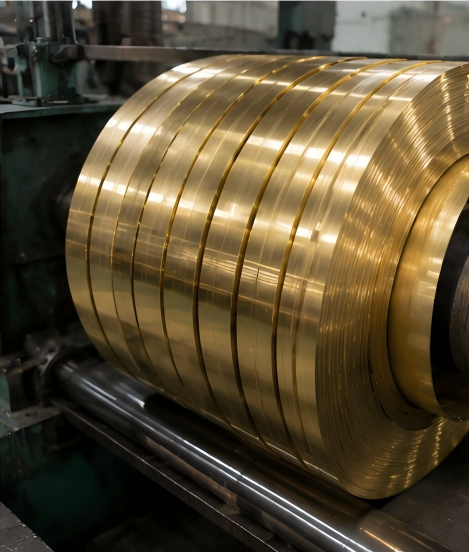
For copper plates and strips — the form from which brass coil is drawn — the published route is hot rolling (breakdown) → cold rolling → annealing → finishing (slitting / leveling).
Key Process Control Points for Brass Coil
For plate, strip, and coil, four control points govern whether material performs in production: thickness tolerance, flatness/shape, absence of surface scratches or indentations, and stamping formability. These are the parameters worth writing into a purchase order, because they map directly onto downstream stamping, slitting, and forming operations. Copper tubes, by contrast, are governed by wall thickness uniformity, inner surface cleanliness, and grain size in the annealed state — a useful reminder that control points differ by product form and should be specified accordingly.
Temper Designations: Matching Coil to the Forming Operation
Temper determines how a brass coil behaves under bending, flaring, and deep drawing:
- M (Soft Temper): fully annealed / soft-annealed; high ductility and low strength; suitable for bending, flaring, and deep drawing. Common designations include T2M and H62M.
- M2 (Light Soft): lightly soft-annealed; properties fall between soft and half-hard tempers; commonly used under the GB/T 1527 standard.
- Y2 (Half-Hard): half-hardened by cold working; balances strength and ductility with good structural support. Designations include T2Y2 and H62Y2.
- Y (Hard Temper): hardened by cold working; high strength and rigidity but poor formability. Designations include T2Y and H62Y.
- O60 (Air Conditioning Tube): soft-annealed temper, a globally recognized designation used in air conditioning and refrigeration, for example TP2 O60.
Quality Documentation and After-Sales Support
Documentation is where many general industrial buyers get caught out. The standard route includes mandatory standard-compliant sampling and retention of test reports for future reference prior to shipment. Copper suppliers can provide material/quality certificates covering chemical composition, mechanical properties, and electrical conductivity, and, upon request, third-party or commercial inspection reports. Buyers should confirm at the quotation stage which documents are issued by default and which require a request.
Jiangsu Xinxiangsheng Special Steel Co., Ltd. supports general industrial buyers with one-to-one professional after-sales support covering these documentation requirements, temper and grade confirmation, and the resolution of order-level questions after delivery — the practical counterpart to the inspection and packaging stage of the production chain.
Pricing and Ordering Practice
Copper and brass products are priced on a floating model: LME/SHFE Copper Price + Processing Fee. Because the metal component moves, the pricing cycle and the method used to lock in the price (price-fixing) should be clarified before an order is placed.
The most useful discipline for a buyer is to specify the four key elements: "Grade + Temper + Cross-section + Standard." For conductive busbars, for example, pure copper busbars such as TMY/T2 or C11000 are recommended, with electrical conductivity typically ≥ 46 m/(Ω·mm²) at 75°C and straightness as key specifications to verify. The same discipline applied to brass coil — grade, temper, cross-section, and standard — removes most of the ambiguity that leads to rejected lots and rework.
A Practical Summary for Industrial Buyers
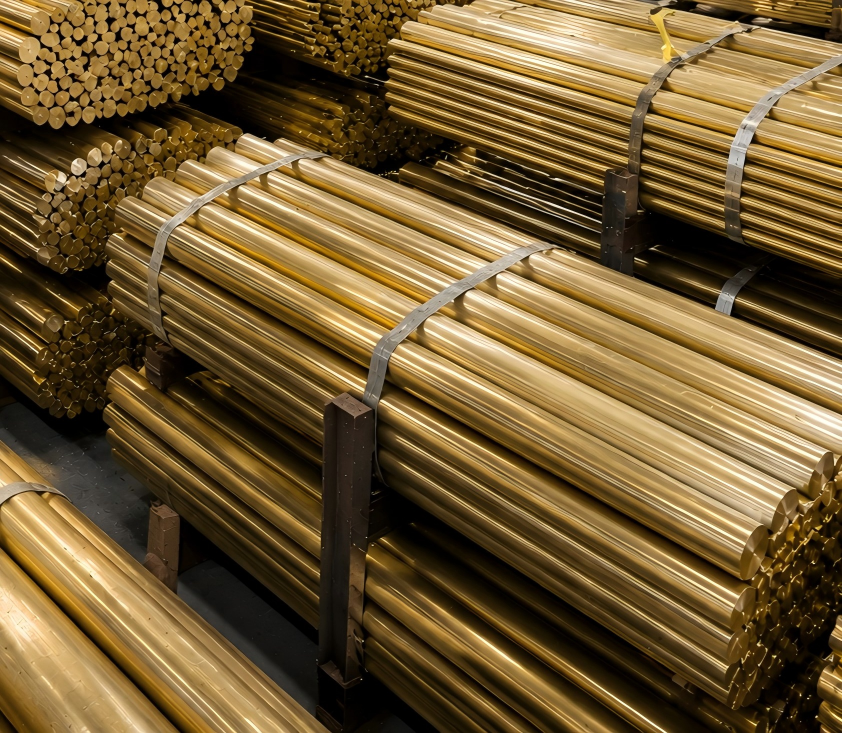
A reliable brass coil supply comes down to verified alloy composition, a documented process chain, defined control points on thickness tolerance, flatness, and surface quality, the correct temper for the forming operation, and inspection documentation that travels with the material. Working with a supplier that can speak to all five — as Jiangsu Xinxiangsheng Special Steel Co., Ltd. does across its brass and copper product range — is what turns a price quote into a repeatable production input.
Related products
-
Quick View
Morbi varius ligula eget ante
Original price was: $55.00.$45.00Current price is: $45.00.Add to cartMaecenas nulla est, dictum quis augue ultrices, dictum rutrum enim. Aliquam erat volutpat. Quisque ultricies ornare lacus, eu sagittis urna euismod ac. Nulla rhoncus ultrices ligula, id maximus ligula ultricies non.
-
Quick View

Donec ullamcorper turpis
$45.00Add to cartAliquam porttitor mattis erat, a eleifend lorem tempor ut. Donec erat lacus, ultricies at dolor sed, accumsan sollicitudin libero. Praesent pellentesque sed odio et fringilla. Donec a semper metus. Nulla mollis sodales sem vitae congue. Donec laoreet nunc sed metus pretium volutpat. Nunc quis feugiat elit.
-
Quick View

Vestibulum ante ipsum primis
$56.00Add to cartCras mollis dolor sed tempor iaculis. Duis ac ante quam. Donec nec justo erat. Nam a augue vel ex venenatis interdum sit amet ac quam. Interdum et malesuada fames ac ante ipsum primis in faucibus. Vestibulum erat lectus, cursus at dui in, fringilla commodo lectus. Quisque eu bibendum quam, eget euismod sem
-
Quick View
Phasellus varius turpis
Original price was: $87.00.$76.00Current price is: $76.00.Add to cartFusce nec diam et dolor ornare rhoncus nec ut mauris. In eleifend mi in felis dictum fermentum. Morbi vel arcu sit amet dolor venenatis bibendum in eu dui. Nulla velit dolor, imperdiet consectetur luctus ut, faucibus eget est.


Reviews
There are no reviews yet.