

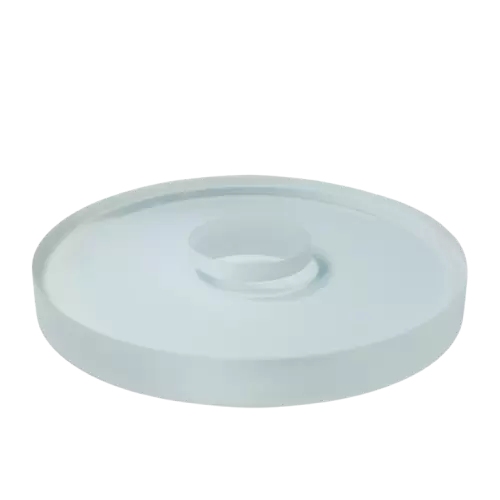
CNC light weight component
The materials used in the astronomical telescope reflectors we supply typically meet the following requirements: 1. Low coefficient of thermal expansion
The optical substrates used in our astronomical telescope reflector systems are selected according to strict performance standards to ensure long-term stability and high-precision imaging under extreme environmental conditions. These materials are engineered to maintain consistent optical behavior under temperature variation, mechanical stress, and long-duration observational use.
To ensure reliable performance in advanced telescope assemblies, the material selection generally follows these core requirements:
-
Extremely low coefficient of thermal expansion to minimize deformation under temperature shifts
-
Minimal stress-induced birefringence for maintaining polarization stability and image clarity
-
High-quality annealing process to improve internal uniformity and structural stability
-
Stable and repeatable optical performance over long operational periods
-
Strict control of inclusions such as bubbles, streaks, and other internal defects
Available Substrate Materials
Silicon
Primarily used in infrared detection systems. Silicon exhibits strong sensitivity within specific infrared wavelength bands, making it suitable for observing low-temperature or low-luminosity celestial targets such as exoplanets, cold cosmic bodies, and deep-space infrared phenomena.
Silicon Carbide (SiC)
Widely used for large-aperture and cryogenic mirror blanks. This material offers high stiffness-to-weight ratio, excellent structural rigidity, and strong thermal conductivity. These characteristics allow the mirror to maintain shape stability even under extremely low-temperature operating environments.
Fused Silica (JGS2)
Commonly applied in high-performance diffraction grating and optical dispersion systems. It provides broad spectral transmission, excellent thermal stability, and strong resistance to radiation, making it suitable for wide-band and high-efficiency spectral analysis in astronomical instruments.
ZERODUR® (Schott)
A premium substrate material used for primary and secondary mirrors in high-end telescope systems. With an ultra-low (near-zero) thermal expansion coefficient, ZERODUR® ensures exceptional dimensional stability even under extreme temperature fluctuations, enabling consistently sharp and distortion-free imaging performance in precision astronomy applications.
Related products
-
Quick View
Phasellus varius turpis
Original price was: $87.00.$76.00Current price is: $76.00.Add to cartFusce nec diam et dolor ornare rhoncus nec ut mauris. In eleifend mi in felis dictum fermentum. Morbi vel arcu sit amet dolor venenatis bibendum in eu dui. Nulla velit dolor, imperdiet consectetur luctus ut, faucibus eget est.
-
Quick View
Pellentesque dignissim sapien semper
$78.00Add to cartCras luctus ultricies ex luctus malesuada. Fusce imperdiet interdum consectetur. Pellentesque dignissim sapien semper consequat sollicitudin. Phasellus iaculis libero ac placerat aliquam. Etiam a velit eu diam consequat vestibulum. Ut a malesuada nulla. Vivamus quis maximus nisi, vel molestie sapien. Nunc pharetra finibus elit sed consectetur.
-
Quick View
Nunc tempus facilisis
$87.00Add to cartFusce ullamcorper dapibus eleifend. Nullam ornare pulvinar lacinia. Nunc tempus facilisis ullamcorper. Nam sit amet suscipit risus, ut ultricies felis. Vivamus a finibus nisi. Sed quam sem, accumsan eget tristique sit amet, suscipit sit amet augue. Duis dolor dui, sagittis at faucibus ac, varius et sapien.
-
Quick View

Aliquam id quam elementum arcu eleifend
$44.00Add to cartAenean bibendum posuere neque, quis hendrerit libero ultrices lacinia. Vestibulum venenatis elit non bibendum pulvinar. In luctus urna sapien, posuere fermentum nunc tempus eget. Fusce hendrerit nec diam quis ornare. Duis auctor, libero in efficitur finibus, purus diam maximus est, et rhoncus sapien justo nec sem

Reviews
There are no reviews yet.