
Popular
-
 Industrial Waste Incineration Solutions for Solid, Liquid and Gas Waste
-
 Certified Non-Standard Automation Parts: Top Manufacturer
-
 Verified Non-Standard Automation Accessories Factory Guide
-
 Non-Standard Automation Parts: OMNIMAKE's OEM/ODM Solutions
-
 Square Drive Flat Head Machine Nails | High Torque Industrial Fasteners
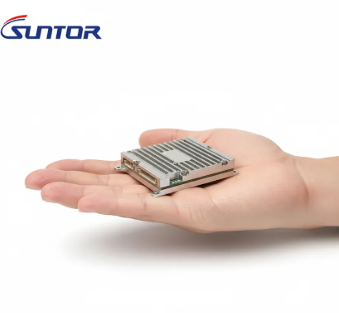
MD01Pro Drone Mesh Radio
▪ Small Size & Light Weight ▪ 1 Watt Transmit Power ▪ 5 Seconds Quick Setup Time ▪ Up to 64 IP Mesh Nodes* ▪ Up to 25Mbps Data Rate** ▪ AES128/256 Security Protection ▪ 30KM Air-to-Ground Transmission
Unlike a typical point-to-point drone video link, an airborne mesh radio works as a node in a mesh network. It can help connect ground teams, vehicles, fixed relay nodes, and command centers through aerial relay.
1. Airborne IP Mesh Radio
Turn UAVs into aerial relay nodes for wider coverage.
The Airborne IP Mesh Radiois designed for UAVs, drones, tethered drones, and aerial relay platforms. It helps extend communication coverage over mountains, forests, valleys, buildings, and other non-line-of-sight areas.
By placing a mesh node in the air, the system creates a better communication path between field teams, vehicles, fixed stations, and command centers.
Key Points
-
Best for:UAV relay, aerial video, emergency communication
-
Data supported:UAV video, relay data, voice, GPS, sensor data
-
Main value:bypasses terrain obstacles and extends network coverage
-
Typical use:wildfire monitoring, mountain rescue, disaster response, wide-area surveillance
Simple Network Diagram
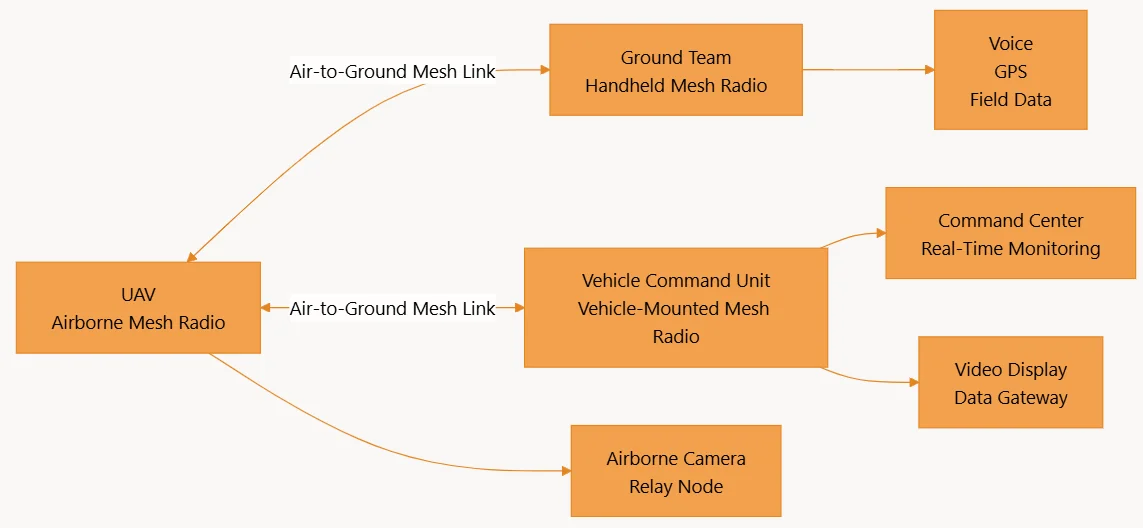
Airborne Mesh Radios turn UAVs into aerial relay nodes, extending communication coverage over mountains, forests, and non-line-of-sight areas. This solution is ideal for emergency response, wildfire monitoring, and wide-area surveillance.
2. Key Features and Practical Benefits
| Feature | Practical Benefit |
|---|---|
| Mesh Networking | Allows multiple fixed and mobile nodes to connect in a flexible network. |
| Mobile Node Access | Supports field teams, vehicles, or unmanned systems moving during operation. |
| IP Data Transmission | Can connect cameras, sensors, and data devices depending on configuration. |
| Relay Capability | Helps extend coverage and reduce blind spots. |
| Flexible Installation | Suitable for field, vehicle, fixed, airborne, or unmanned platform deployment. |
3. What to Confirm Before Choosing This Model
| Item | Why It Matters |
|---|---|
| Site Environment | Terrain, buildings, slopes, and obstacles affect coverage. |
| Node Quantity | Determines network structure and relay planning. |
| Mobility | Moving vehicles or teams require different deployment methods. |
| Data Type | Video, voice, GPS, and IP data require bandwidth planning. |
| Power Supply | Field, vehicle, battery, or fixed power affects model selection. |
| Installation Position | Antenna height and device location affect link performance. |
4. Introduction
The 1W airborne mesh radio is suitable for lightweight UAV platforms that need to work as an aerial mesh node or short-range aerial relay in a private wireless network. It is recommended for small UAV integration, temporary aerial relay testing, emergency observation, and field communication support where low weight and low power consumption are important.
This model is suitable when the UAV has limited payload capacity and the airborne node is mainly used to improve local communication coverage between ground teams and nearby mesh nodes.
Specifications
| Wireless | System | ||
|---|---|---|---|
| Frequency Range | 1350-1450MHz(Customized) | Video Input | ETH(HDMI/SDI for Optional) |
| Bandwidth | 2.5M/5M/10MHz | Audio Input | N/A |
| Transmission System | COFDM | Security | AES128/256 Encryption |
| Modulation Mode | BPSK/QPSK/16QAM/64QAM (Self-Adaption) | Power Supply | DC8-28V Wide Range Voltage Power Supply |
| Data Rate | 25Mbps@10MHz(Peak) | Power Consumption | ≤ 5W(Typical), ≤ 10W(Peak) |
| RF Power | 0.5W × 2 | ||
| Receive Sensitivity | ≤ -100dBm@5MHz | Networking | |
| Networking Capability | 2 / 4 / 8 / 16 / 32 Nodes | ||
| Interface | Networking Hops | 1 / 2 / 3 / 4 / 10 Hops | |
| RF Antenna | MMCX× 2 | Access Time | 5s after Startup of System |
| GPS Antenna | N/A | Topology Type | Ad-Hoc Network, Star Network, |
| WIFI Antenna | N/A | Chain Network | |
| Ethernet Interface | HC1.25 × 1 | ||
| Serial PortInterface | HC1.25 × 3 (RS232× 2, TTL× 1) | Physical | |
| S.BUS Interface | HC1.25 × 1 | Dimension | ≤ 66× 48× 11.5mm |
| Power Interface | HC1.25 × 1 | Weight | ≤ 50g(Host Only) |
| Protection Level | N/A | ||
| Operating Temperature | -40°C~+55°C | ||
Typical Solutions
|
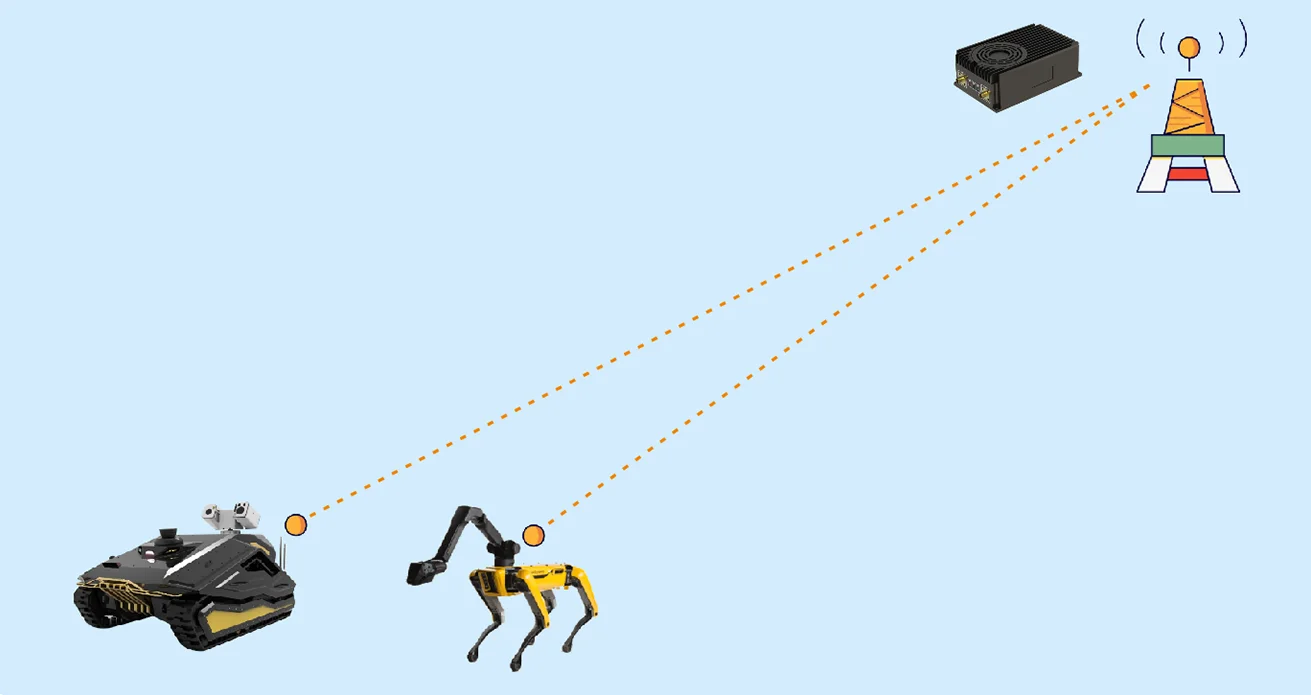
Unmanned Vehicle Communication Solution |
Robot Remote Control Solution |
|
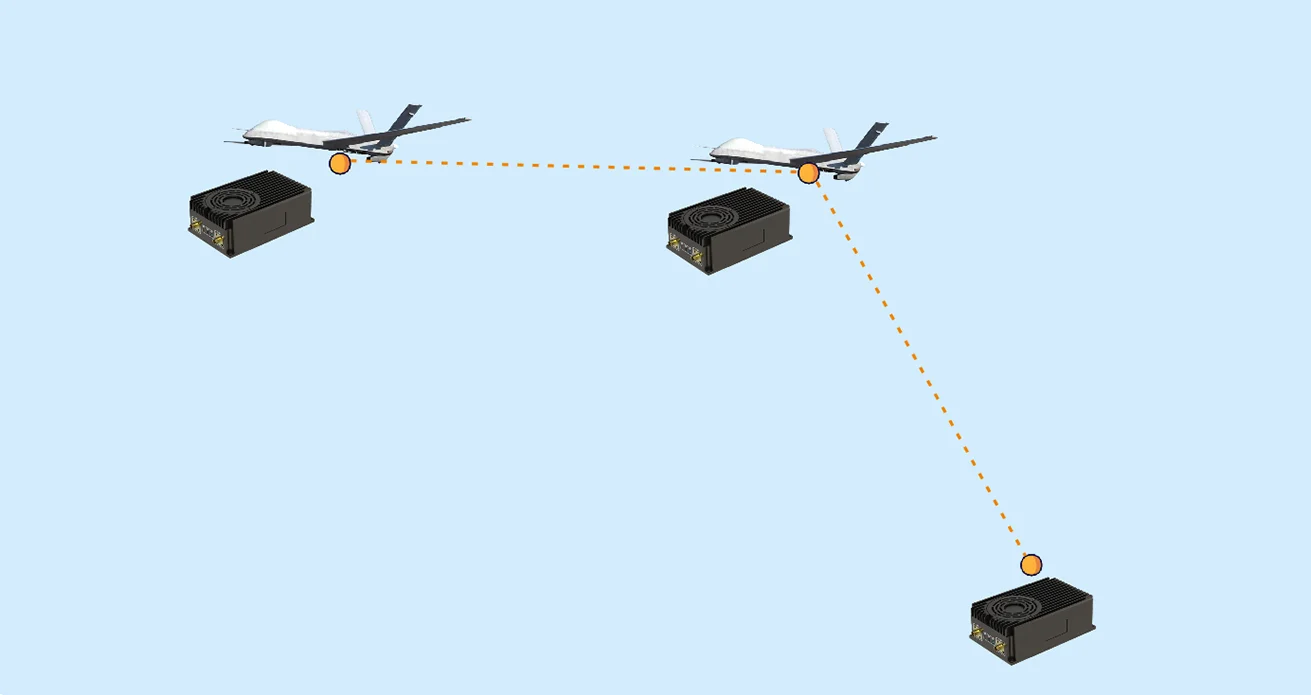
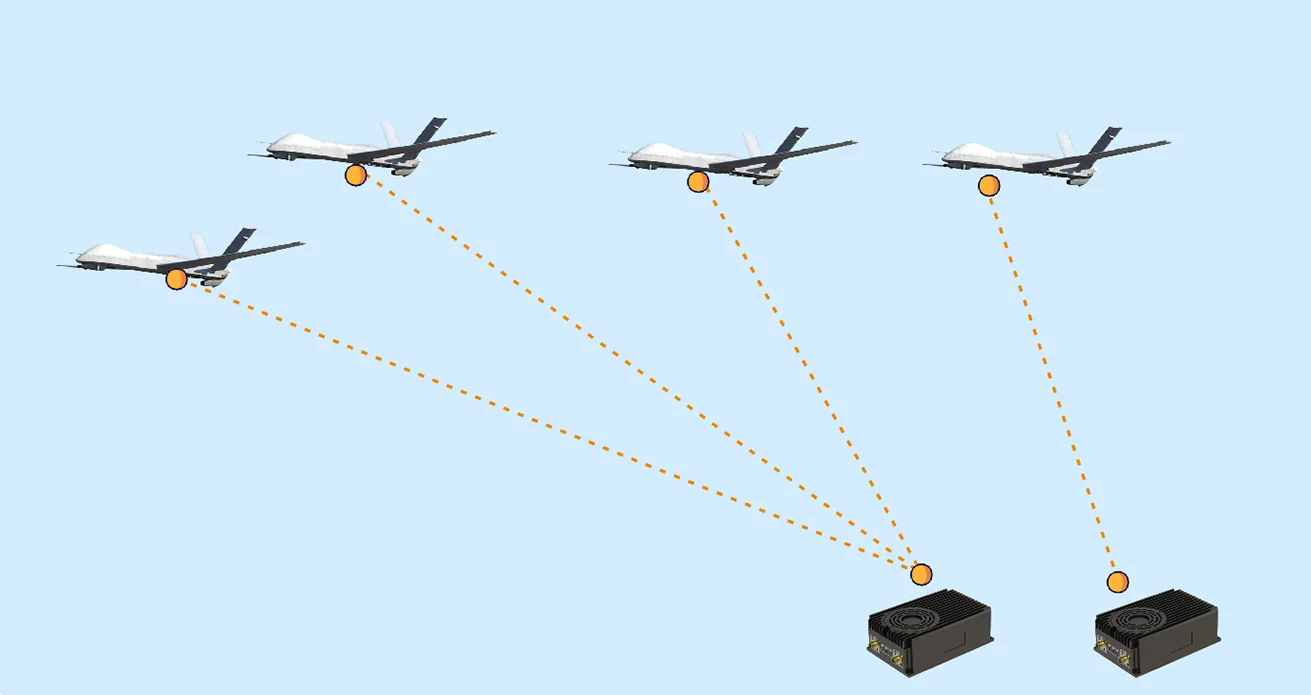
PTP, MPTP Drone Communication Solution |
Relay Communication Solution for Drone |
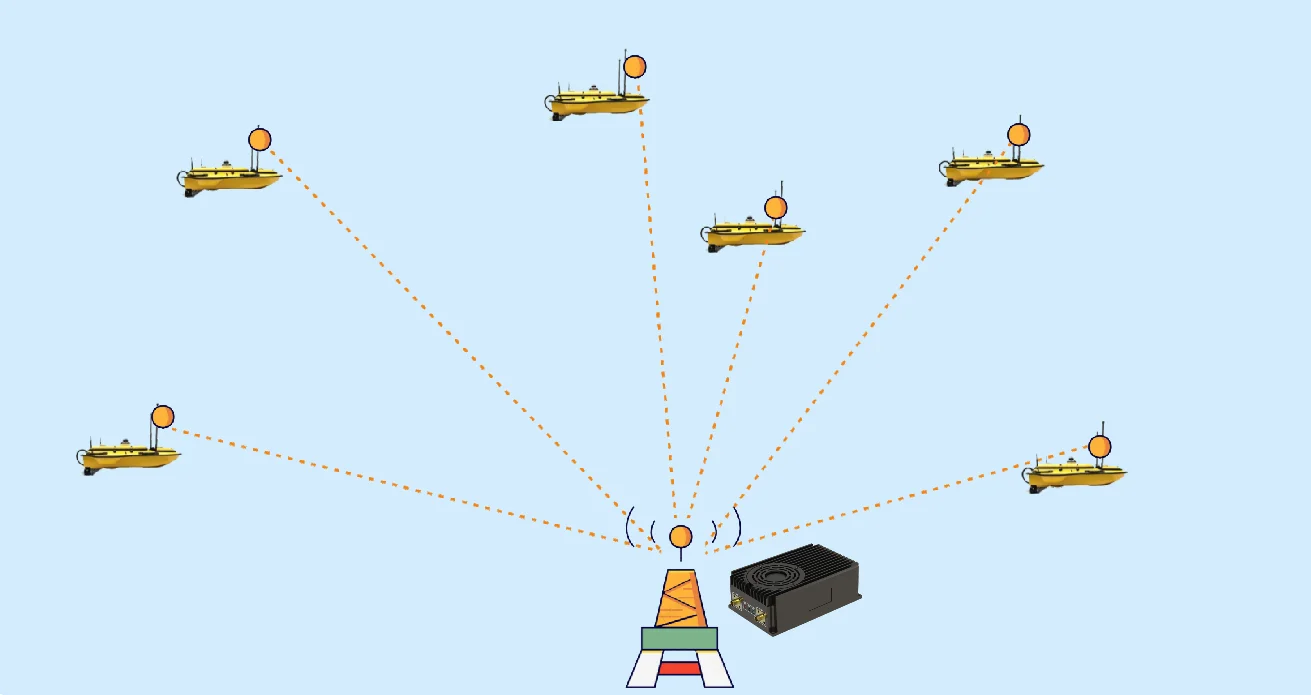
5. Application
| Application | Why It Fits |
|---|---|
| Lightweight UAV Relay | Suitable for small UAV platforms with limited payload. |
| Emergency Observation | Helps create a temporary aerial communication point. |
| Field Team Support | Connects nearby ground teams and vehicle nodes. |
| Aerial Relay Testing | Useful for UAV integration and network testing. |
| Local Coverage Improvement | Helps reduce small terrain-related blind spots. |
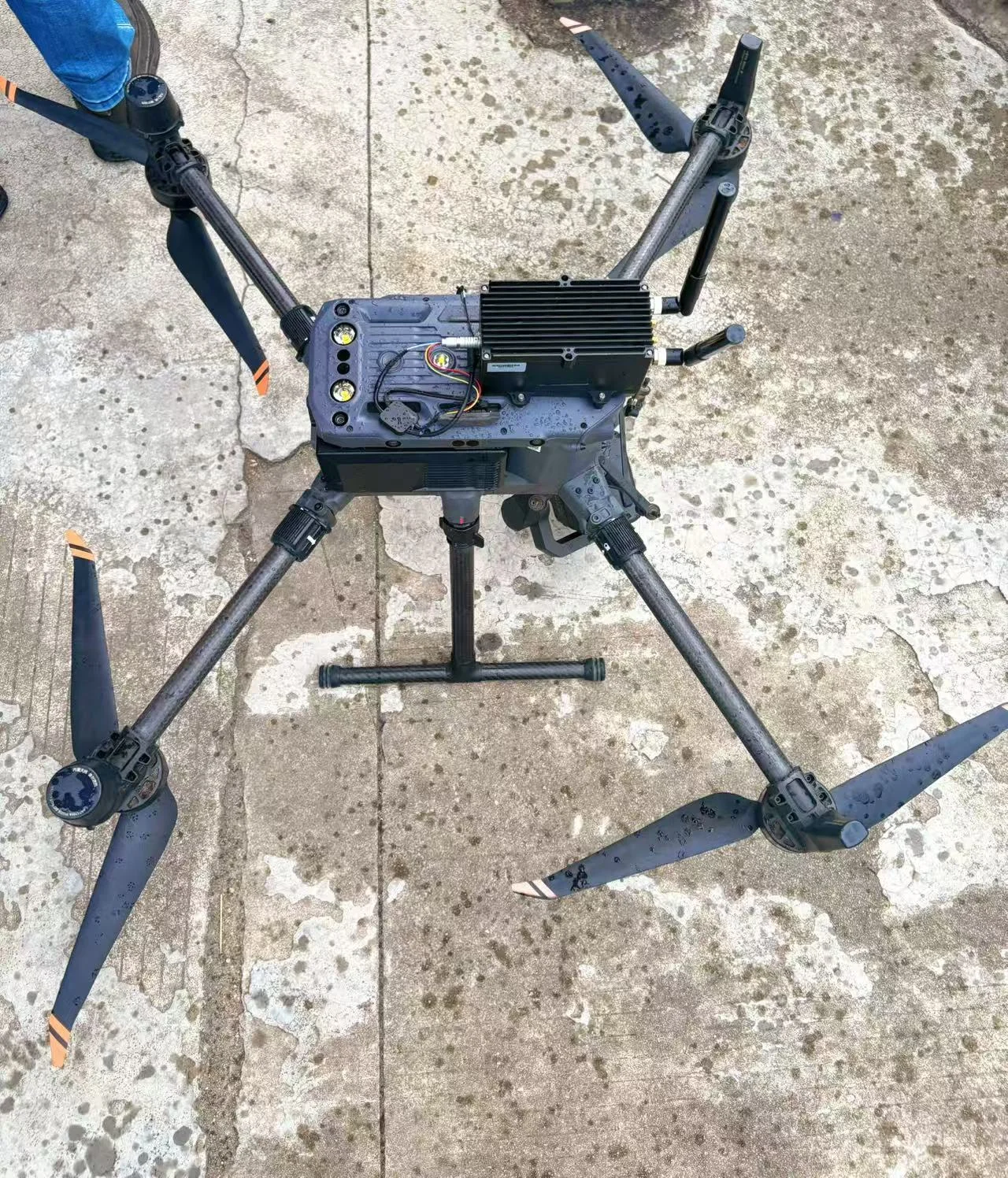
Brief Case: 1W Airborne Mesh Radio for Lightweight UAV Relay Testing
A small UAV platform in China used a 1W airborne mesh radio as a temporary aerial relay node during field communication testing. The airborne node helped connect nearby ground workers with a vehicle-mounted mesh radio. Before integration, air unit weight, power supply, antenna position, flight time, and local relay area were confirmed.
Related products
-
Quick View
APIO 24 inch smart mobile screen
Contact UsAC100-240V.50-60HZ , Output: DC12V 4A(Input: AC100-240V.50-60HZ, output: DC12V 4A :Power source specification
-
Quick View
GJXFH FTTH Indoor Flat Fiber Optic Drop Cable for Efficient Indoor Fiber Deployment
Contact UsThe indoor fiber optical drop cable was developed to connect optical equipment indoors in FTTh network branches.
Reviews
There are no reviews yet.